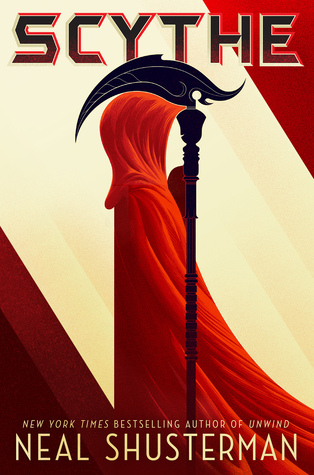
Humanity has come a long way. War, hunger, misery, disease, and aging have been eradicated. Now that age really is just a number, death doesn't occur either. Which isn't a problem, except for the over-population issue. So in order to control the population, scythes have the non-enviable profession of "gleaning," choosing and then killing individuals.
When Scythe Faraday stops by Citra Terranova's house, it's not for a gleaning; it's for supper. And when Rowan Damisch offers compassion to a fellow student picked to be gleaned, his high school experience becomes unbearable. Citra and Rowan's lives intersect when both are chosen to become scythe apprentices. Although each considers refusing, their families don't protest the opportunity -- they're given immunity from gleaning as long as that family member is a scythe.
The plan is for Citra and Rowan to be tested against each other at the Winter Conclave. Whoever does best will become a scythe while the other will go back to their "regular" life. So for the next year, the two learn the profession of bringing death. They struggle with the moral issues of living and dying, and they learn various ways to end a life. They learn Bokator, a martial art, and become acquainted with toxic chemicals. At the Vernal Conclave, they're both tested (and do poorly). Afterward, Scythe Goddard mentions his displeasure with Scythe Faraday mentoring
two apprentices. Goddard's wicked solution creates higher stakes for Citra and Rowan, and exposes cracks in the political system.
When their master chooses to glean himself, Citra and Rowan are separated, sent to other scythes to continue their apprenticeships. They learn not all scythes are created equal, and their training diverges.
Scythe by Neil Shusterman is one of the most thought-provoking YA fantasies I've read in a long time. Despite the morbid subject matter, the violence wasn't gratuitous and moved the plot forward. Although our culture's always looking to turn back the clock, this read had me considering the wisdom of living forever. The world building, a look at what our world might become, was fascinating -- I enjoyed the touches Shusterman added to show how our world had changed and not all of the modifications were for the better.
As mentioned before, there is some blood and violence, so I wouldn't recommend it for younger YA readers. But for the older set, it could open up interesting conversations about what it means to grow older, how our culture treats death and dying, and how our faith changes our outlook on such issues.
Scythe is part of a series, and the next book will be released in January 2018.