Showing posts with label Lauricia. Show all posts

Friday, August 12, 2022

Weekend Reads: The Demon King (Lauricia)

 Greetings, all!

I hope all is well with you and yours! As I type, I'm enjoying a much-needed rain, the third-ish in a chain that recently broke a months-long drought with consistently record highs. Most of the trees, bushes, and grasses have been dry brown for most of the summer. Now, thanks to three days of afternoon showers, they have green tops! It's kind-of bizarre. Needless to say, I have avoided the scorching dryness by staying inside my air-conditioned home and reading. My most recently discovered treasure is this weekend's recommended reading: The Demon King (Seven Realms Book One) by Cinda Williams Chima.


Within the Seven Realms, the Queendom of the Fells is divided between the wizards, the Spirit Clans, and the Fellisians. Each group has scorned and despised the others for over a century, since the Breaking. Antagonized by the economic and political strains that accompany the civil war in other realms, tempers in the Queendom flare among the groups, ratcheting tensions to the breaking point. Raisa ana'Marianna, daughter of the clans and thirty-seventh descendant of the warrior queen Hanalea, longs to unify the peoples of the Queendom, but all of her efforts are blocked by Lord Gavan Bayar, the High Wizard of the Wizard Council who seems to be scandalously more than her mother the Queen's advisor.

Han Allister is a reformed Streetlord known for his silver cuffs, wide bracelets worth a fortune if he could only remove them. In order to stay off the streets, Han spends most of his time among the Spirit Clans, hunting for game and herbs he can sell in the Fells. It's a modest living, but it works well enough until wizards come to the Clan's lands, where they are forbidden. Han's encounter with Micah Bayar, son of the most powerful wizard in the Queendom, incites a series of events that go from bad to worse and cause Han to wonder if he wouldn't have been better off on the streets.

The Demon King is the first book in a four book series that is a refreshingly different story about trust and love in the face of insurmountable odds. This series takes place in an original cultural setting that blends the usual medieval trappings with tribal elements of cultures like the Indigenous Americans. Raisa is a strong female lead who is unique in her lack of reactivity. Instead of believing what she's told and reacting to unfounded revelations, she consistently insists that accusers provide evidence for their claims and only proceeds when she knows the facts of a situation, which I found very satisfying. The story is also masterfully woven across the entire series. I normally take small breaks between the books in a series, but I devoured all four of these books back-to-back. You will, too, so make sure you have all four books before you start.


If you read any of this series, I'd love to know what you think. Leave a comment or connect with me on Facebook or Instagram.

Until next time, happy reading!

Friday, June 17, 2022

Weekend Reads: Mistborn by Brandon Sanderson

 Greetings, all, and happy summer! I hope you and yours are well and enjoying some sort of much needed rest.

I apologize profusely for the tardiness of this post. If you're an avid or regular follower, you'll notice that this post wasn't released at the usual time. This is because I hyper-extended my elbow last week and have had a bit of trouble doing life, so my schedule got pushed back significantly. However, they say better late than never, so here I am at last to share my latest recommendation, which is Mistborn by Brandon Sanderson.

For those of you who don't know, Sanderson is a renown author of fantasy with quite a long list of titles. I've known of him for a while, and I listen to his writing podcast, but I hadn't read anything by him until now because, well... you know what To Be Read piles are like!


Vin is one lucky street rat, which is good because an orphan in the underground needs all the luck she can get. Her luck is so strong that it rubs off on others. As long as it holds, Vin gets to stay alive.

Kelsier is the most renown thief in Luthadel. The only survivor of the mines of Hathsin, Kelsier is about to hatch the most audacious plan ever considered in the Final Empire. He can't possibly succeed, but there's a small chance things may go his way, nonetheless. All he needs is a little bit of luck, which he sees in Vin.

As a fan of epic fantasy, I enjoyed Mistborn very much. It is a heist-style story (Think Ocean's Eleven) with a magic system that is unique and very well though out. Vin is likable and relatable, and is reluctant in a realistic way without overdoing it. She even challenges what the reader comes to accept as the norm for the world of the story, questioning the views of everyone on both sides of the main issues in a refreshing way. The romantic interest is a clueless bookworm I was totally drawn to because of the people in my life that he reminds me of, and the plot twists were unpredictable yet right. I haven't read the rest of the series yet, but I very much enjoyed this one and recommend it highly.


If you read any of these recommendations, I'd love to know what you think. Leave a comment or connect with me on Facebook or Instagram.

Until next time, happy reading!

Friday, April 22, 2022

Weekend Reads: My Top Picks for Next-to-Read (Lauricia)

Greetings, all, and happy spring. I hope you and yours are well!

I'm taking a bit of a different angle on my contribution to the blog today. As you know from my last post in February, I'm super crunched for reading time in the spring. I've also had some pretty intense health problems, but rather than back out of this month's post, I've decided to share a few books from my Want to Read pile and to tell you why. I'm familiar with these authors from Realm Makers, an international organization of Christian authors of speculative fiction, so I can promise that all of these recommendations are appropriate for audiences who read only clean fiction.


My first pick for you is Curio by Evangeline Denmark. Here's the blurb:

“Grey Haward has always detested the Chemists, the magicians-come-scientists who rule her small western town. But she has always followed the rules, taking the potion the Chemists ration out that helps the town’s people survive. A potion that Grey suspects she—like her grandfather and father—may not actually need.

By working at her grandfather’s repair shop, sorting the small gears and dusting the curio cabinet inside, Grey has tried to stay unnoticed—or as unnoticed as a tall, strong girl can in a town of diminutive, underdeveloped citizens. Then her best friend, Whit, is caught by the Chemists’ enforcers after trying to protect Grey one night, and after seeing the extent of his punishment, suddenly taking risks seems the only decision she can make.

But with the risk comes the reality that the Chemists know her family’s secret, and the Chemists soon decide to use her for their own purposes. Panicked, Grey retreats to the only safe place she knows—her grandfather’s shop. There, however, a larger secret confronts her when her touch unlocks the old curio cabinet in the corner and reveals a world where porcelain and clockwork people are real. There, she could find the key that may save Whit’s life and also end the Chemists’ dark rule forever.”


I”ll be honest with you, The first thing that drew me to this book is its cover. I mean, the colors are gorgeous and the image promises steampunk fantasy – what's not to love? Also, Grey's conflict is realistic and personal while coinciding with the epic nature of saving the world, so I'm super intrigued.


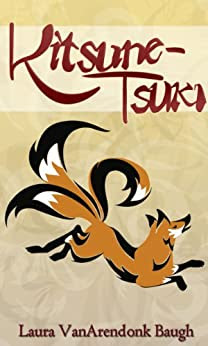
My next pick is Kitsune-Tsuki by Laura VanArendonk Baugh. The blurb for this one reads:

“How does one find a shapeshifter who may not even exist?

The onmyouji Tsurugu no Kiyomori, a practitioner of the mystic arts, has been engaged to protect the warlord's new bride from the fox spirit rumored to be near. Tsurugu and the shadow-warrior Shishio Hitoshi face an impossible challenge in teasing out a kitsune shapeshifter from the samurai and servants – if such a creature is even present at all.

The handsome mute twin servants belonging to Lady Kaede are certainly suspicious, but it is the beautiful and strong-willed lady herself who draws Shishio’s mistrust. Tsurugu and Shishio must move carefully, for accusing the warlord’s bride falsely would be death. But failing to identify the kitsune to the warlord is equally perilous, and there is more to discover. For an onmyouji knows secrets even the shadows do not….

Kitsune-Tsuki is a historical fiction novelette, the introduction to the series KITSUNE TALES. By reader request it includes a full glossary as well.”


I can't wait to dive into this one because I LOVE Japanese fairy tales and absolutely adore kitsune. Yes, I know they're traditionally demonic, soul-sucking man-devourers, but I'm enamored with the non-evil renditions: the woman-to-fox shape-shifting, the mystique, and the cunning beauty. Add that to the concept of this story, and I'm all in.


My third recommendation for you today is Havok Magazine. The blurb for the first edition says:

“Enjoy the debut issue of Havok Magazine, your source for the highest quality speculative flash fiction. New York Times bestselling author Tosca Lee headlines this issue with the beautiful story of a young woman who faces incredible odds when a murderous horde attacks her people.

Staff member Lindsay Franklin enlightens our audiences with "Hardwired," a story of a cyborg who falls in love. Plus, read six other speculative fiction stories ranging from a steampunk Pinocchio to a woman who literally married a monster.”


Full disclosure: I'm cheating a little bit with this one. I follow Havok on their Instagram page and subscribe to the magazine already, and I very much enjoy it. I'm not including it in this list because it's in my to-be-read pile, I'm including it because it should be in yours. You can get a taste for what's inside this magazine by reading the free story of the day on their website at https://gohavok.com/.

Do it. Do it now.


If you read any of these recommendations, I'd love to know what you think. Leave a comment or connect with me on Facebook or Instagram.

Until next time, happy reading!

Friday, February 25, 2022

Weekend Reads: Blood Rose Rebellion (Lauricia)

 I have a huge reading problem this time of year – I don't do a lot of reading for fun. I'm usually hip-deep in analytically reading a classic or two for one of the classes I'm teaching. On top of that, I like to help judge a few novel competitions, and I can't really talk about the stories I'm judging because of non-disclosure agreements. It's a happy problem, really, but sometimes it makes it difficult to find books to recommend. It's times like this when I reach into the past, to a time before I blogged for Lands Uncharted, looking for books I've read but haven't recommended yet on this blog. With that in mind, my recommendation for you this weekend is one such novel: The Blood Rose Rebellion (Blood Rose Rebellion, Book One) by Rosalyn Eves. [A third round of research revealed that I did, in fact, mention this book as part of a post in 2019, but that was forever ago in terms of internet time, and this book deserves it's own blog post, so here you go.]


Anna Arden has a problem: she's magic-less in a world where social rank is determined by magical ability. More than that, she's known for the uncanny way spells go wrong when she's around. After this ability ruins the social debut of Anna's sister, their mother sends Anna away, hiding her in Hungary until her sister is safely married. But there's more to Anna's lack of magic than anyone in her family could understand. So much more that Anna gets caught up in a rebellion set to change her world forever.

Set in Victorian England, Blood Rose Rebellion is an alternate history fantasy filled with the nuances and social critique of a Jane Austen novel. I enjoyed it for its detailed world building and realistic character development. Anna is easy to relate to and to identify with, as are the major support characters, and the decisions she makes, as well as the twists in the plot, are believable and satisfying. Blood Rose Rebellion is a great read for fans of Pride and Prejudice and Les Miserables, as well as those who would enjoy Victorian England with a magical flare.

I hope you enjoy this story. If you read it, I'd love to know what you think. Tell me your thoughts below.

Until next time, happy reading!
Tuesday, November 30, 2021

Note Card Organization | Writer's Life (Lauricia)

 I love journals. Whenever I see a blank stack of paper, my fingers itch with the urge to find the nearest pen and fill each page with line after line of story. Add a stylish cover and the sale is practically made, whether I need a new journal or not. This minor compulsion is so strong that my elder son is prone to pushing me ever-so-subtly past the stationary aisle of whatever store we happen to be in at the time.

One lovely side-effect of my addiction is the benefit a new journal brings to my writing. As already mentioned, a new journal begs to be filled, so it can be a great means of inspiration for me on those days when it’s oh-so-hard to write. Not only is a journal a great place to sketch out scenes for my current work in progress, it’s also a fabulous place to keep notes and ideas.

At least, until I need to find those scenes, notes, and ideas.

Because of my love of journals, I have a whole collection of them. Flipping through them to find a half-remembered story idea or a tidbit of inspiration is time consuming and, often, quite frustrating in spite of the elaborate indexing and coding system I’ve developed to prevent such frustration-inducing experiences. I had given up on finding any better system, ascribing the time lost while questing through journals as part of a writer’s lot, until I learned of a revolutionary new idea: note cards.


In 2018, I discovered the phenomenon that is podcasting. A short while later, I drove through a suburb of Houston listening to podcasts randomly shuffled from the list on my phone. (My vehicle’s audio system syncs to my phone. How cool is that?) As I sat in rush-hour traffic waiting for my turn to be cut off by a light that changed color much too quickly, my phone landed on a show called the Hope Writers podcast. On episode 03-07, titled “How to Capture and Organize all of Your Writing Ideas,” the hosts of the blog discuss a way of using note cards to organize writing ideas and inspirations. The system is so much like the one that I teach to my students as they compile information for research papers that I felt as if a 2x4 had struck my head. I swear I heard the timber plank crack as it figuratively crashed upside my skull.

The basic idea is this: instead of carrying a journal in which to scribble whatever piques your fancy, carry a deck of note cards. Jot one idea per card then, when you’re ready to begin a new project, organize those cards by topic and viola! Another application is to organize those cards by idea (setting, character, conflict…) and file them in a box according to whatever system works best for you. It sounds so simple, but I cannot tell you how much this idea has revolutionized my writing life. I found a durable but light-weight note card pocket at my local office supply store, so I can keep my note cards in my purse or bag without worrying that they will become tattered. This has allowed me to downsize my Mary Poppins-style bag to a cute purse and reduce the weight I consistently carry on my shoulder because of said bag. I don’t leave tons of unused pages in a journal because I left them blank in case I needed to add to the idea already begun there. It is easy to punch a hole in the note cards and add them to whatever upcoming story binder they belong to. (You know: those stories you can’t write yet but know you will soon. I collect those ideas most likely to be developed into full stories in three-ring binders of their own and add scene, conflict, and character details as I find them.) It’s also a great way to inspire creativity: find a few cards that connect in an intriguing way and you’ve got a new story idea or novel.

The possibilities are truly endless. Not only that, this system allows me to actually finish a journal to the point where I can pack it away and actually justify my next foray into the stationary aisle or—even better—office supply store.

While I’m not a fan of reinventing the wheel, I do appreciate discovering ways to make it run more smoothly. If you have any organizational tips or tricks you can’t live without, I would love to hear them in the comments below.


This blog was originally written for the #AuthorToolboxBlogHop in March of 2018.


Friday, June 25, 2021

Weekend Reads: The Rook by Daniel O'Malley (Lauricia)

 Greetings and happy summer!

I know school is still weird as we're still dealing with the effects of the pandemic, but no matter where you are on the scale of no school to full school, I hope you are well and enjoying your favorite things. Especially an abundance of good stories.

Speaking of good stories, I have been on a roll lately with the books that I have been choosing. I WANTED to review The King's Spell by E.J. Kitchens, but I'm a little late to that party (see posts for June 17 and June 22). Even so, if you haven't read it yet, you REALLY need to. It's fabulous!

After The King's Spell, one of the recent titles I have read that I think you will enjoy is The Rook (The Rook Files Book 1), by Daniel O'Malley.


Myfanwy Thomas (pronounced “Miffany”) is a high-level operative in a secret agency that protects the world from supernatural threats.

Or so she's been told. She doesn't remember anything before the moment she found herself standing in the rain, surrounded by a ring of unconscious bodies all wearing latex gloves.

Guided by letters written by the previous inhabitant of her body (whom she thinks of as Thomas), Myfanwy learns how to navigate her role in the agency while trying to discover who wiped out her memory and why. In the process she unearths a conspiracy among her fellow agents and realizes that being herself is significantly more important than trying to live the way others expect of her.

I can't tell you any more than this without giving something away. The plot of this story is so tightly woven that revealing anything could easily spoil the entire experience.

I was so interested in this book that I actually bought this book for my To Be Read pile twice. Let that be a warning to you: keep track of what waits in your TBR pile! A blend of Mission Impossible and Men in Black, this spy thriller kept me completely engrossed. I even laughed out loud often enough to make my older son interested. I highly recommend this read for fans of the superhero genre and fans of speculative literature who are looking for something a little different. For those who are selective of content, there are a few infrequent instances of cussing, and there is a lot of violence and gore.

I'd love to know what you think of this book. I'm also curious to know what you've read lately that you've really enjoyed. Let me know in the comments!

Tuesday, May 25, 2021

Story Snippets: Guardian Prince (Lauricia)

Greetings once again, all!

I hope you are well and well-read. We are getting A LOT of rain where I live, but my house is high and dry, so I'm not too worried. Plus, it's great reading weather, and school's almost out for the summer, which means A LOT of reading time for me!

Today I'm sharing a snippet from my recent release, Guardian Prince (book two in the Ceryn Roh Saga). As you know, I'm a huge fan of fantasy, but it always vexed me that a deity-based magic system could be ultimately controlled by mortals. I always that thought that if mortals received magical ability from a deity, that deity should have the authority to decide when and if the mortals get to use it, or else why was he/she the deity? In Guardian Prince, I chose to explore what a deity-based magic system would look like if the deity whose power is being used not only could but did say, "No." This excerpt is one of Sabine's introductions to that kind of magic system. I hope you enjoy!


    Sabine followed a dry stream bed until she came upon a large stone jutting out into the path. Water marks stained the lower half, revealing the gradual recession of the river that had once flowed around the rock. The top was relatively smooth and flat, so Sabine sat upon it, settling into the safe, familiar comfort of being alone in the woods.

    She had not been there very long when she heard the snap of a twig. Sabine tensed, suddenly alert, but the noises of the animals around her continued unchanged, so whatever had moved nearby was not unfamiliar to the surrounding animals. Since this meant it was not an Aethel, she relaxed.

    “You have good instincts,” Koen said as he emerged from behind a nearby tree, “but you dropped your guard too soon. Although the forest knows me, that doesn't mean I'm safe for you.”

    “Koen,” Sabine greeted the Dryht tersely. Frustration flared within her, stirred to new life by his intrusion. “What are you doing here?”

    One corner of the Dryht's mouth curved wryly. “Communing with the forest. It's what Dryht do. Mind if I join you?”

    Before Sabine could say no, he sat beside her on the rock.

    “How soon do you expect to hear from Gaoth,” Sabine asked, her tone more terse than she intended. 

    “The bird is fast, but he gets distracted. A juicy berry here or a lovely she-raven there, and business is a lost priority. I don't expect him until morning.”

Sabine nodded, but grimaced inwardly. So much for that topic. “So...you knew my friend Mariel?” 

    Koen nodded. “She did much to fight for the freedom of your people. She was not strong in her use of magic, but she was diligent. She worked hard to master her ability.”

    Sabine shook her head. “I never would have thought it.”

    “That was rather the point,” the Dryht countered. “What about you? Your mentor believed you held even more potential than your friend. Shall we find out?”

    “What, now?”

    Koen glanced around, exaggerating the action as if to make a point. “You have pressing business elsewhere?”

    “All right,” Sabine consented. She truly wanted to say no, but it was clear the Dryht was not going away. “How do we begin?”

    "Technique,” Koen stated simply. “The last time we spoke of this, we discussed how all magic comes from one of two sources: the will of Torian or of Nymhon, depending on whom you serve. So. Now you learn how to tap into that power.”

    “Let me guess,” Sabine said when she recognized the Dryht's silence as a prompt. “A prayer? A chant? An incantation?”

    “All of those are options,” the Dryht conceded, his tone reluctant, “but each of them is time consuming. It's really just a simple matter of the will. You focus on what you want to happen, will it to occur, and it happens.”

    “As long as Torian allows it,” Sabine amended, recalling the night of Aodhan’s rescue. She had certainly wanted the arrowhead out of his shoulder, but nothing had come of it.

    “Yes, there is that. Still, calling on your will is much faster than any other option and is preferable in any number of situations.”

    Sabine was about to ask for an example, but she remembered when she had first used magic to rescue Danelle's baby from being still-born and kept quiet. As she considered it further, she could imagine many instances in healing when time made all the difference. “I suppose this method is the easiest to learn as well?”

    “Actually, no. The benefit to prayers, chants, and the like is that they help you narrow your focus and pinpoint your will. It takes much discipline to focus your will without them, because you can be easily distracted by everything around you. You must be able to block everything else out.”

    That shouldn't be a problem, Sabine mused, since she had been blocking out distractions all her life: her mother's criticism and negativity, her sister's snide comments. Blocking things came easily to her. 

    “Sabine,” Koen prompted. “Are you still listening?”

    “Yes,” she replied, chagrined at the way she had let her thoughts wander. So much for focus.

    “Then watch.” The Dryht held out his hand. A moment later a butterfly rested in his palm, opening   and closing its wings a few times before fluttering away.

    "Did you make that?"

    Koen chuckled and pointed to the opposite bank of the dry riverbed. “No. Creation of something from nothing is reserved only for Torian and the Creator God. I simply moved it from that flower over there.”


Friday, April 23, 2021

Weekend Reads: Jane Eyre (Lauricia)

 Happy April, everyone! Can you believe we’re already one-fourth of the way through the year? Where I live spring is running a little bit late, as we’re experiencing unseasonably cold weather, but everything is blooming anyway, as if to defy the temperatures. This weekend even promises rain, which means perfect reading weather!

For those of you who don’t know, I teach high school English for ninth through twelfth grades at a small private school. All of my classes read at least four novels per year in addition to their regular coursework, and I like to re-read the books I teach about once every five or so years. Currently I’m re-reading Jane Eyre by Charlotte Bronte, and I’m having a grand time, which is why I’m recommending it for this week’s Weekend Reads.


Jane Eyre is perfect for fantasy lovers because it was written during two literary periods that appeal to our enjoyment of the supernatural: the Romantic period and the Gothic period. Without using my teacher-voice, literature written during the Romantic period is characterized in one aspect by spiritual and supernatural elements. Gothic literature is an exploration of the dark side of man, so it is filled with elements such as ghosts, lunatics, crumbled castles and mansions, and the like. Both of these periods make Jane Eyre the perfect classic for lovers of fantasy.


The novel tells the story of Jane Eyre as she grows from youth into adulthood. It is divided into five parts, and this go-around I’m noticing each part seems to have hints of a specific fairy tale. The parts are referred to by the locations where Jane lives: Gateshead, Lowood, Thornfield, Moor House, and Fernden. I’m only in the middle of the book, but my students and I agree that the Gateshead section contains definite Cinderella vibes and the Lowood section smacks of Little Red Riding Hood. Our first impression of Thornfield was echoes of Beauty and the Beast, but Charlotte Bronte actually refers to the Legend of Bluebeard in this one, so we had to concede the point; especially when we met the character named Bertha Mason. I’m excited to see which fairy tales (if any) can be found in the last two sections. I’m guessing Snow White for Moor House, but I can’t remember much about Fernden yet, and I refuse to “cheat” by looking it up until after I’ve finished the book.


Other elements of this story include ghosts, a lunatic who lives in an attic, lots of references to fairies and elves, and a classic romance that helped establish the archetype of the moody but desirable male lead. If you’re looking to read outside the strictly fantasy genre, but you don’t want to deviate too far, Jane Eyre is the book you need to read next.


Are there any pieces of classic literature that you're fond of? I'd love to hear about them, or about your impressions of Jane Eyre if you've read it, in the comments.

Tuesday, March 23, 2021

Writer's Life: My Favorite Piece of Writing Advice (Lauricia)

Greetings, all, and welcome back to Lands Uncharted. I hope this post finds you and yours well and in good health. For today’s blog, I’d like to offer you the single piece of advice that I find to be invaluable.

I spend a significant amount of time in the car during the week, and as I do, I like to listen to podcasts about writing. One episode I heard last week contained this piece of advice that I decided is pure genius: trust your process.


Image by Free-Photos from Pixabay


Trust your process.

As we set out on our paths to become writers, or progress on our journeys to become better writers, it is natural to look at other authors and consider how they “do it.” How does this author publish so many books each year? How does that one consistently write well enough to win all of those awards? How can I become a better writer so that I can stand on the playing field with them? Our desire to create stories that are good enough to get noticed in a crowded market can lead us to examine the processes of others, which is how we grow. As we try the various production techniques of other authors and see which fit, we begin to develop a system of our own.

And then we begin to compare. We may notice that this author produces at an astonishing rate of three books per year, and we wonder why we’re not churning out stories that quickly. Or we see that author winning yet another award, and we wonder why our writing doesn’t even make it to the short list of any competition we enter. We begin to doubt the processes we’re using, and we think that if we could just find that one thing that those other writers do, we could finally shoulder our way onto the bookshelves. So we try other people’s processes but find that what works for them doesn’t work for us. This writer produces so many books because she writes every day, but I can’t write every day because my day job demands a lot of my mental resources, and I’m creatively spent when I get home. Or that writer uses this technique blended with that technique to produce award-winning plots, yet those same techniques frustrate me and leave my creative wheels spinning.

Somewhere along the path of becoming better writers, we get caught up in the processes of others and become trapped in a pattern of comparison and competition until we’re so tangled up in techniques and methods that we don’t even want to put words on a page any more.

It is good to try the things that work for other authors. If we don’t consistently try new methods, we won’t find those that help us and we won’t grow in ability or skill. The problem arises when we abandon what works for us in favor of what works for someone else and get frustrated when that thing that works for someone else doesn’t work for us.

For example, I currently teach five different classes of high school English. This means I prepare five different lessons each day, which takes a lot of creativity. Then I teach those classes, which takes a lot of energy. Then, after the school day ends, I grade the work produced by my students during those classes, which often means I don’t have any creativity, energy, or time to invest in my own writing, so I can’t write every day. A lot of authors will tell you to write every day, which is an excellent piece of advice, but if I let myself be defeated because I can’t seem to find a twenty-fifth hour in a twenty-four hour day, then I would give up and never produce the works that I have managed to create. If, instead, I use that advice to try to improve my process but abandon it when it doesn’t work for me, then I am able to develop a system that enables me to get the words in my heart and my head out onto the page. I may not be producing a book every year, but I am at least producing consistently.

I share all of this to encourage you as you make your way along the writer’s path. It is good to study the methods and try out the techniques of other authors, but if they don’t help you, it’s also good to set them aside. What is important is not what works for someone else, but what works for you. Find those things that help you create stories you love and build those methods and techniques into a system that matches your personality and lifestyle. Then trust your process as you write those stories you long to tell.

Friday, February 19, 2021

Weekend Reads: The Near Witch by V. E. Schwab (Lauricia)

Greetings, all!

As I’m writing to you this month, Texas is emerging like a burrowing mammal from our great Icepocolypse. The sun is finally shining in a clear sky, and the temperature is finally scheduled to rise above freezing. Those of you in the north may scoff, but we southerners are simply not prepared for this type of weather. As a meme I saw phrased it, “I love that no one in Texas owns actual snow clothes. It’ll snow and you’ll see everyone outside in mismatched pajamas and a hoodie.” Not to mention four layers of socks on our hands for gloves. It just doesn’t make sense to own clothing for weather that usually occurs only once in a decade or so!

But enough of the weather. We’re here to talk about books you need to read. For this weekend, I recommend The Near Witch by V. E. Schwab.


In the village of Near, the winds on the moors sing a haunting song. It’s best not to listen too closely, though, because bad things happen to those who do. Like the boy Jack, whose mysterious death led to the mob hunt and murder of the Near witch two generations ago.

Lexi knows the story, but still the wind calls, its haunting tune trying to tell her something if only she would listen just a little closer. She can’t let the wind distract her, though, because the children of Near are disappearing, whisked away from their beds during the night. Lexi has to find out why, or her little sister could be next.


The Near Witch is one of those stories that contains everything I love about the fantasy genre: mystery, magic, a touch of romance, and an able heroine I can relate to. It’s a “quiet and strange” story, in the author’s words. Quiet and strange in the style of Howl’s Moving Castle by Diana Wynne Jones and Neverwhere and Stardust by Neil Gaiman. Quiet and strange in the way that I am most drawn to in a story.

I don’t remember how I found this book, but I am supremely glad that I did, and that I bought the hardback version because it’s going to have a long life on my shelf of treasures. I hope you adore it just as much.

Until next time, happy reading!

Tuesday, January 19, 2021

Story Snippets: Guardian Prince (Lauricia)

 Greetings, Friends!

Welcome back to Lands Uncharted. Today I'm sharing another snippet from my newest release, Guardian Prince, which is the second book in the Ceryn Roh Saga. This series is  a high fantasy epic set in a world where Humans are subjugated by the an elvin race known as the Rüddan. Ripped from her home and forced to collude with an ancient enemy, Sabine Rhyonselle is pursued across the world of Ceryn Roh as she races to find the Human godstone before the Rüddan annihilate her entire race. Guardian Prince is available from Amazon in paperback and ebook.

Below is an excerpt from chapter 13. I hope you enjoy!


Rounding the corner at the end of the hall, Sabine was so caught up in her thoughts that she almost didn’t see the two figures standing in a shadowed corner near the stairwell. Startled, she backtracked instantly, then chided herself for being so skittish. Even though she was a Human, she had as much right to be here as anyone else. Pushing her shoulders back and raising her chin, she began to proceed forward when another thought stopped her.

The two figures stood in the shadows, in an unused part of the castle, and she had not heard their voices or anything else to let her know they were there. What if they were meeting secretly, with no desire to be discovered? Pressing herself against the wall, she peeked around the corner.

The two figures were deep in conversation and didn’t appear to have noticed her. At first the shadows made it hard to discern their features, but after a few moments Sabine thought she could identify Amala’s golden hair. The Aethel woman stood with her back to Sabine, mostly obscuring the man she spoke with. However, based on the rich brown of his hair and the sky-blue-and-misty-white color scheme of his rather elegant clothes, Sabine surmised it was Maeron, the courtesan Sabine occasionally saw in the Great Hall.

Quietly, so as not to disturb them, Sabine pulled her head back. Although it surprised her to see Amala here, hadn’t Diera said that Lord Maeron sought Amala’s affections? Both Sabine and Amala were left to their own devices for the evening meal, so it was entirely possible for Lord Maeron to invite Amala to an unused part of the castle where he thought they wouldn’t be disturbed. Judging by the looks Amala frequently shot at Aodhan, Maeron didn’t stand a chance, but who was Sabine to interrupt his attempts to woo the Aethel woman?

No one, Sabine thought. Grinning smugly at the idea of leaving Amala to her eager suitor, Sabine retreated the way she had come, backtracking to the library in search of another route to the kitchen.

She was not halfway back to the double doors when she smelled the smoke. It was not a heavy scent—not like new wood burning in a clean fireplace. Rather, it smelled faintly like a campfire, redolent of charred wood and ashes.

Like the scent that is said to precede the Hannori. Sabine shuddered at the thought. According to her father’s stories, the actual physical manifestation of a servant of Nymhon looked like a shadow and smelled of something burning. If the Ayrhim were real, couldn’t the Hannori be real, too?

According to the stories, Sabine thought again, then groaned. The stories she was studying with Tayte must be winding up her imagination. What would a Hannori be doing here, in a deserted corridor? Besides, all the doors were locked—she had checked most of them herself—and all of the glowing orbs had been dark, except for the ones Amala and Maeron must have triggered. There was no one here to summon a Hannori.

Convinced she had imagined the scent, Sabine continued down the hall…

… and almost slammed into Gaelan as he exited a nearby room, carrying an armful of thick candles.

Sabine nearly choked on a scream that stuck in her throat. Gaelan grunted and dropped a few candles, which Sabine helped him retrieve. They were still warm, as if they had been burned for a while and had just been extinguished. That explains the smoke smell.

“Human,” Gaelan grunted, accepting the candles from her. “What are you doing?”

“Exploring,” Sabine said before she could think of a better response. “I’m still learning my way around. What about you?”

Gaelan eyed Sabine, looking as if he weren’t going to answer, then grimaced and said, “Guard duty.”

Glancing at the candles, Sabine arched her eyebrows.

“It’s true.” Gaelan stood taller and positioned his feet in a battle stance. Speaking in a theatrical tone, he declared, “I, Gaelan, Lord of Eddonwe Keep and head of the Royal Guard, am embarked upon the most noble of all guard duties: rat patrol.”

“Rat patrol?” Sabine barely managed to contain her laughter. “With candles?”

“Ahh, you see, fair lady-in-waiting,” Gaelan retorted, his tone turning conspiratorial, “one must have light to see them by, and the rodents of this keep hate our glowing orbs. They hide from the harsh glare and will only venture out in complete dark or in the yellow glow of a candle.”

Sabine assessed the Aethel captain, certain he was mocking her. “Is that so?”

Gaelan nodded. When he spoke again, his tone was back to normal. “It’s usually a punishment detail, but I lost a bet. A commanding officer is nothing if he is not a man of his word, so here I am.”

“Hmmm,” Sabine put on her best expression of pity, but didn’t try to make it too convincing since she was still fairly sure Gaelan jested at her expense. Did the Aethel not have rat traps? “In that case, I should leave you to your campaign. Happy hunting.”

“My lady,” Gaelan said, saluting her by touching the edge of a candle to his forehead.

Flashing a bemused smile but still not expressing any belief in his tale, Sabine returned to the library at last and made her way quickly to the kitchen and her dinner.


Friday, December 18, 2020

Weekend Reads: Fairy Tales Punk'd, Edited by Phoebe Darqueling (Lauricia)

I have a confession. I haven’t read a lot worth recommending lately.

To be fair, it’s the fall semester at school. This means I’m uber-busy grading the assignments from my classes, and I have little time to read. However, in the time that I have carved out for reading, the books I’ve chosen lately have been… lackluster at best.

Until yesterday, when I started Fairy Tales Punk’d, a short story collection edited by Phoebe Darqueling. Technically released December 15th, I didn’t find it in my Kindle queue until late on the 16th. I had pre-ordered it because I’ve had the honor of working with Phoebe, so I’ve been looking forward to it for a while, but my schedule… Anyway, early on the morning of the 17th, I was able to start this long-awaited work. So far, it has been an excellent investment of my time.


This book is an anthology of fairy tale remixes told from a steampunk point of view. Although I’m only just able to indulge, the first story did not disappoint. Titled “Making Bones”, this steampunked retelling of Cinderella takes place in the mob-culture of early 1900’s America and does not end the way you expect it will. Subtle but effective in her incorporation of the story’s core elements, Darqueling does a fabulous job of making the story her own and offering a version that’s nothing like anything you’ve ever read before.

I devoured it, even though it meant I was sure to be late for work.

Then I moved on to the next story, titled “Star Tsarina”.

I didn’t get very far because I’m a rule-follower, and I really couldn’t be late for work. Someone needs to supervise all of those students, after all. But I got far enough to discover that the second story in the anthology is a science fiction version of Snow White. I think. I’m pretty sure. I’m definitely going to stay up way too late tonight to find out, because the early 1990’s Russia setting translated to interplanetary space is too intriguing to pass up. Who needs a good night’s sleep, anyway?

The good news is, the semester is over as of Friday and I can retreat into the deep cave of reading for pleasure as soon as my school’s last bell rings. Since this anthology has eleven stories which almost certainly include a Little Red Riding Hood retelling and a Rapunzel retelling based on the titles, I should be well satisfied for the first few days of my holiday.

I hope that you are finding a lot of time to indulge in reading, and I hope your reading choices all end in discovering good stories. As this is my last post for the year, I leave you with a prayer for a peaceful, joyful, and love-filled Christmas and a new year filled with fantasy that transports you beyond the mundane but also equips you with the courage to face the monsters in your world. We at Land’s Uncharted appreciate you readers and your support more than we can express, and we look forward to exploring the world of fantasy stories with you again throughout the next year.

Until then, Merry Christmas!

Tuesday, November 17, 2020

Writer's Life: No Plot? No Pants? No Problem! (Lauricia)

 “Are you a plotter or a pantster?”

Utter this question in a group of writers and watch from a safe distance as the formerly unified whole splits into two parts like the ground on a fault line in an earthquake (and with about as much noise). Notice the shifty glances cast as writers discreetly shuffle to one side or the other of the gap now forming, ever-so-subtly aligning themselves with those who are likeminded. Look on and wonder, “What have I done?”

What you have done, my friend, is broached one of today’s literary hot topics.

While the divide is not nearly so dramatic as an earthquake, many authors are firmly established as one or the other, and knowing which side you stand on could be foundational in your career as a writer.


A plotter is someone who outlines an entire work before sitting down to actually write it. Writing this way gives authors a detailed map, allowing them to plan minute details before even writing a word.

 A pantster, on the other hand, is someone who writes without the outline, literally “flying by the seat of the pants”. Pantsters prefer this method because it allows the story to grow more organically, and allows the writer to be surprised during the writing process.

Well known plotters include Katherine Anne Porter, John Grisham, R.L. Stein, and J.K. Rowling. Nora Roberts, Margaret Atwood, Pierce Brown, and Stephen King are among the pantsters. Many authors fall into one of the two camps, and you can find a lot of resources online to help you identify which style suits you the most.

Me, however… I’m more of an excavator. As I’m playing with my initial idea, I find scenes scattered throughout the plot like bones peeking through surface dirt. I craft those scenes carefully, executing the tools to hand as precisely as an architect excavates fragile skeletal fragments from the earth. Once out in the open, I hang them on a plot diagram in rough-guestimation about where they belong. As I write, more of the current work’s structure is exposed, and a better picture of the overall whole begins to form, allowing me to plan the positioning and execution of the elements of the work accordingly.

Much like exhuming a fossilized skeleton from the ground, my method is slow, painstaking work. It requires many drafts, but what work-in-progress (WiP) doesn’t? And, oh, the surprises I find along the way!

If, like me, you find you are neither a plotter nor a pantster, never fear. Writing is subjective, even down to its very creation, and no to authors work exactly the same way. My suggest is to experiment with both plotting and pantsing, borrow what works from each method, and meld them into a combination of your own. Then, when your WiP is completely excavated and ready to be viewed by the masses, look on and wonder at the amazing thing you have done.

What about you? Do you write best as a plotter, a pantster, or an excavator? Let us know in the comments below.

Friday, October 16, 2020

Weekend Reads: The Hallowed Hunt by Lois McMaster Bujold (Lauricia)

Happy October!

I love autumn, and October is my favorite month of the year. Not only do we get at least a little respite from the summer heat here in southeast Texas, but I am absolutely enchanted by the mellow quality of the sunlight that only comes in autumn; the colors of the leaves; the mists that rise in the mornings; and the rich smells that speak to me of ancient days and mystery. *sigh*

My Weekend Reads pick this month is a bit of a risk. It’s a clean read, but it does contain a small smidge of language in that it uses the more… colorful… word for “illegitimate son”. However, as this same word has a real and appropriate meaning, I’m considering this a gray area open to personal interpretation and preference, so I’m taking the risk and recommending The Hallowed Hunt by Lois McMaster Bujold. Here’s why:


Lord Ingrey kin Wilfcliff is a man haunted by a terrible destiny. Cursed at a young age to bear the spirit of a wolf, he lives a life of balance between being a disinherited but valued swordsman and being killed to rid the world of the danger encompassed in the wolf spirit he carries. He manages to keep the spirit subdued until he is sent to retrieve the body of the murdered Prince Boleso and to arrest the noblewoman accused of killing him. As he transports Lady Ijada to her trial and works to unravel the mysterious circumstances surrounding Prince Boleso’s death, Ingrey encounters a dangerous spell, a kindred spirit, a madman who can’t die, and multiple gods. He also discovers that the accused murderer he is escorting may be the only person he can trust.

First published in 2005, this book is actually the third in a series but reads as a standalone. The first two books (The Curse of Chalion and Paladin of Souls) each follow different protagonists, so this story works on its own. I had no trouble slipping into it, and I never felt as if I was missing information from the other books.

I really enjoyed the classic fantasy feel of this story, but what I loved most was the redemption scene at the midpoint. The characters of this world worship a pantheon of gods comprised of Father, Mother, Son, Daughter, and…illegitimate son (my phrase, not Bujold’s). When Lord Ingrey experiences an encounter with the Son, the scene is such a perfect rendition of an undeserving soul experiencing the cleansing redemption of Christ that I was moved to tears. Truly, which is why I’m taking the chance to recommend this book.

I’d love to know what you think about appropriate and inappropriate language in your reading and in our recommendations. Please share your preferences and your reasons for them in the comments below.

Tuesday, July 14, 2020

What To Do With Your Story Idea: Publishing (Lauricia)

Welcome to this final installment of my answer to the question of what to do with a story idea. If you’re just popping in for the first time, you can find a list and links to the entire series at the end of today’s post.

If you have been following along for a while, congratulations! You now have a (very basic) introduction of how to take a story idea through to developed product and are ready for the final step: publication.

In today’s publishing landscape, authors have three options when it comes to getting their stories out to the public: traditional publishing with a large publishing house; traditional publishing with a small house; or independent publishing.


It used to be that traditional publishing was the only legitimate option and independent (also known as “indie”) publishing was looked down upon. Then Amazon appeared, introducing print on demand, and the entire face of publishing changed. Now both paths to publication are equally validated and equally valid. Rather than being an us-against-them scenario, it’s more a case of what works best for each individual. When deciding which route is best for you, you should consider the costs and benefits of each option.

In traditional publishing with a large house, authors submit their works to publishers either directly or (as is increasingly being demanded) via an agent. If the publisher agrees to represent a novel, the author signs a contract and works with the publisher to get the book into print. The benefit to this option is cost and expertise. Large publishing houses often offer advances to their authors. They also carry the expenses associated with publication: editing, layout and formatting, and advertising. They have massive distribution, and they may also help with marketing. The drawback of this form of publishing is exclusivity: since any publisher can only print so many books per year, it is very hard to get contracted by a major publisher. Also, authors often have little control over the finished product.

Traditional publishing with a small house offers many of the same benefits as being published with a large house. Depending on their budgets, they cover most of the costs associated with publishing and help with advertising, and they are easier to get contracted with. However, they seldom offer advances and have limited distribution.

Independent publishing is almost the inverse of traditional publishing. There is no exclusivity as you are responsible for what gets published when, but you bear all of the costs. You must find and pay for people to edit your work, to design the layout and format, and to design a cover. While it is certainly possible to do all of these things yourself, and there are good resources out there to help you, keep in mind that a lack of quality in any of these areas can cause readers to lose interest. Because independent publishing is so accessible, hundreds of thousands of books are being published every year. This means it is hard to stand out and be noticed, so your published work must be polished to its highest shine in order to get noticed.

As ever, this post only glances across the surface of what’s available in publishing. The nuances for each option discussed are myriad, so you should invest some serious time in researching each one further before making a decision. Some of my favorite resources for publishing in general are:

-          - The Steve Laube Agency Blog: https://stevelaube.com/blog/

-         -  Between the Lines: The Books & Such Literary Management Agency Blog:  https://www.booksandsuch.com/blog/

-          - The Novel Marketing Podcast: https://www.authormedia.com/novel-marketing/

-          - The Creative Penn Podcast: https://www.thecreativepenn.com/podcasts/

 Thank you, once again, for joining us on the blog. If you have any further questions about anything related to this series, please let me know in the comments.

As promised above, here's the complete list of what to do with your story idea:

1. Write down everything you know about the story idea. Keep writing until you can’t think of anything to add. (Read more here.)

2. When you’re not writing, work on your social media platform.  Develop your on-line presence authentically, in a way that is genuine. (Read more here.)

3. Go back to your idea. Organize everything you wrote in step one into something with structure and shape. Turn that collection of ideas into a plan and begin your first draft. (Read more here.)

4. Start a website. A blog is good because it gives readers a taste of your writing, but if you feel that you can’t commit to a blog, then you need to have a website at the very least. (Read more here.)

5. Edit your first draft. Complete this step as often as necessary. (Read more here.)

6. Start an e-mail list. (Read more here.)

7. Enlist alpha readers who will give you story feedback. (Read more here.)

8. Once your book is as polished as you can get it, enlist someone else to edit it. (Read more here.)

9. Decide how you want to publish (indie or traditional) and study the process. Learning the necessary details will save you a lot of time and, potentially, a lot of money in the long run.

10. Start the next story!