Showing posts with label Mary Schlegel. Show all posts

Tuesday, November 9, 2021

Story Snippets: Son of the Shield (Mary)

 I am neck-deep in getting ready to release my epic fantasy novel, Son of the Shield, Book 1 of the Ransom Trilogy, in February, so I thought it would be fun to use that as my story snippet this month! (I wish I could share the cover art with this sample, but it's still in production so for now you'll just have to take my word for it being awesome!)

Son of the Shield features a lot of really intense and heavy scenes, but I decided to feature a more fun, lighthearted one...though I'm sure we can all empathize to some degree with the awkwardness Orienne is feeling. ; )

*

The sun was sinking in a bath of winter-golden light, casting sharp, crazy shadows through the leafless trees, and a gentle but frigid wind had drawn a thin veil of lacy clouds over the pale sky when Orienne made the walk back up the hill from the village to the fort.

She was bone-weary, but couldn’t remember when she’d last had such a pleasant afternoon. She’d spent the last several hours helping the women of the village fill their wood boxes, feed their animals, clean their barns, and finish a variety of other chores. They’d all thanked her profusely as though she’d made some great sacrifice, but in truth she almost felt as though she’d taken advantage of them, using their moment of need as an opportunity to indulge her own desires.

Their lives were so simple, so enviably perfect—of course not really perfect, as the problem of the Moorden fire and subsequent absence of the village’s men attested—but wasn’t that just the point? The primary problems in these people’s lives were an accidental fire and being short handed for afternoon chores. Not war, not tense diplomatic meetings, not absurd offers of armistice, not assassination attempts.

Just the simple, mundane problems of a simple, mundane life.

By comparison, it was perfect.

Not for the first time, Orienne contemplated resigning from her diplomatic position and leaving the capital for someplace like Sutton Village—Farindel boasted scores of such tiny, remote villages—since waiting for the war to end was proving in vain. But doing so would take her away from Allegar—Allegar, who had first committed himself as a soldier, and now dedicated his entire life to Farindel’s service as one of the Ransom. He was all the family she had left and she was loath to leave him for that reason, but it also felt so unfair, so selfish, to yearn so strongly for a life the war didn’t dictate, when he had accepted that role freely.

And now she was back in the place she had reasoned herself into so many times: that her only chance at a life free from war was to pray and hope for the war to end.

“Orienne, there you are!”

She stopped and pushed back the hood of her cloak as Allegar strode toward her across the fort’s courtyard, grinning.

“I’ve been looking everywhere for you,” he said.

“Is anything wrong?”

“Hardly!” He put one arm around her shoulders and gestured with his other hand at a second man coming towards them. “Will you look at what the wind blew through the gates while you were out?”

The approaching man was about Allegar’s age, though not quite as tall, with blond hair, blue-gray eyes, and facial features that were vaguely familiar—more and more familiar, the longer she looked at him. He wore civilian clothes, but the sword and scabbard on his belt were marked with the shield-and-wyvern insignia of the military.

His eyes widened when he looked at her. “Allegar, this cannot be Orienne.”

He knew her—but from where? Orienne wanted to study his face more closely, hoping to locate a memory of him, but was afraid to risk making eye contact lest her eyes betray the awkwardness she felt.

Allegar laughed and squeezed Orienne’s shoulders. “A bit different than last time, eh?”

“A bit?” The man laughed, blinking in disbelief. “That’s putting it mildly.”

Orienne nudged Allegar’s ribcage with her elbow, trying to signal that she had no idea who this person was, but he said nothing, so she did her best to smile politely in spite of the blush she felt crawling up her neck. No doubt her eyes were as pink as her face.

“Please, forgive me for staring—I’m just so taken aback! It is so good to see you again, Orienne!” the stranger said, extending his hand, palm-down.

Orienne rested her hand on top of his a bit uneasily. “Hello,” she said, meeting his eyes only briefly. His smile stirred something in her, something she’d felt before. Why couldn’t she remember his name?

After a moment’s pause, he withdrew his hand and chuckled. “You don’t remember me, do you?”

Orienne cringed and forced herself to meet his eyes. “I know your face, but—I am so sorry—I have no name to put with it.”

The stranger glanced at Allegar, one side of his mouth tipped up in a mischievous smile. “Can I tell her now?”

Allegar leaned closer to Orienne and whispered: “Think Harrowby.”

Orienne shuffled through memories of the village where she and Allegar had grown up. Neighbors, relatives, friends… She gasped as the stranger suddenly fell into place among them. “Sorek Ronarres?”

He threw his head back. “Ha! You do remember!”

Remember? Orienne was shocked it had taken her so long to place him. She forced an uncomfortable laugh, trying in vain not to blush even more now that she realized who he was. “I—I can’t believe it, it must be…how many years?”

“Eleven, we figure,” Allegar said.

Eleven years ago Orienne was only twelve. Sorek was a lanky, awkward eighteen-year-old, Allegar’s best friend…and the sole object of Orienne’s girlish infatuation. Now, time had replaced his coltish gangliness with a mature, rugged physique and features. A healthy, well-maintained beard grew where before only thin, straggly wisps had struggled for existence, and his unbridled energy had settled into warm cheerfulness.

“You’ve…changed,” Orienne managed.

“I’ve changed?” Sorek laughed. “What about you? You were just a little girl when you two left Harrowby.”

Orienne groaned inwardly, remembering how she’d hung on everything Sorek said, the way her heart had fluttered every time he happened to glance her way…and the entire time she’d been nothing but “a little girl” in his eyes.

Friday, October 8, 2021

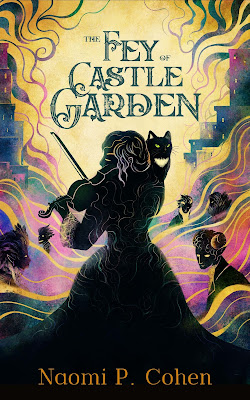
Weekend Reads: The Fey of Castle Garden (Upcoming Release) - Mary

 For this episode of Weekend Reads I am SO excited to get to share the upcoming release by Naomi P. Cohen, The Fey of Castle Garden!


Official Blurb:

New York City, 1859: On Samhain night, a mage pledged to the Wild Hunt is violently murdered. Tensions between the Hunt and Triona, Fey Queen of Central Park, heat up and threaten to boil over into a full-scale conflict. Sofia De Benedetti, mage and musician in Triona’s court, has her hands full making enough money to support herself and help women who are down on their luck in the rough corners of the city. Now a fey war looms and a mage killer is on the prowl. Everything Sofia has built since immigrating, and her life itself, is at risk. With the help of a cait sidhe and a tempestuous storm fey, Sofia must find the murderer before the streets of the city erupt into a magical battleground.


This book is utterly magical. It's a shorter read, one that feels like treating yourself to a tiny, beautifully artistic, and deliciously sweet fancy dessert from a five-star restaurant.

I'm a big fan of literary fiction, and while this book has a very clearly-defined plot unlike the literary genre, Cohen's vivid, luscious descriptions echo the enchanting tradition of L.M. Montgomery (my personal favorite).

This book also boasts a very unique setting, but one that meshes perfectly with the genre to make it highly unique. Cohen has done a fantastic and well thought-out job of interpreting and expanding urban fantasy and Irish mythology tropes into new realms. As I was beta reading it, I kept finding myself thinking "I want to live in this world!"

The Fey of Castle Garden is set to release on October 31st, 2021. If you like Irish mythology, urban fantasy in historical settings, gorgeous descriptions of magical creatures and realms, and Jane Austen-esque explorations of a society's inter-class dynamics, you will want to have this book in hand to begin reading this Halloween!

Friday, August 6, 2021

Weekend Reads: The Magicians and Mrs. Quent (Mary)

 Blame it on my rebellious streak, my desire to be unorthodox and live off the beaten path, but when I see every bookstagrammer in the world gushing and fawning over the same book, when Barnes and Noble has entire kiosks set up to display their selection of different cover art and themed merchandise from said book...I usually have no interest at all in that book.

I much prefer the books nobody has ever heard of, those quirky, out-of-the-way titles you won't see on bookstagram or in glitzy Barnes and Noble displays.

And I love, love, love historical fantasy.

So when my best friend loaned me The Magicians and Mrs. Quent by Galen Beckett, I was utterly captivated.

In an Austen- and Bronte-esque fantasy world where no two days or nights are ever the same length, Ivy Lockwood and her sisters and mother are struggling to keep their family together after their father, a brilliant scientist, has lost his mind. With a mysterious star growing brighter in the sky, greedy relatives circling like jackals to snap up their home, and their father's invention - a model of their solar system - slowly revolving towards a catastrophic conjunction, Ivy is forced to turn to unusual sources for help. Along the way, she finds unexpected love...and unexpected abilities.

Don't get me wrong, the story is great. But it was the world building that made this book so utterly, incredibly captivating. Maybe it was the similarities to the worlds of stories like Pride and Prejudice and Jane Eyre. Maybe it was the detailed exploration of what life would be like in a world with erratic days and nights. Whatever it was, I felt like I could get transported into this world and know my way around perfectly. It is absolutely delicious and I could read and re-read this book over and over, just to keep living in the story world.

So if you're looking for something a little off the beaten path, and you love both fantasy and Jane Austen, you will go crazy over this book. It's the best fantasy experience you've never heard of!

Tuesday, July 6, 2021

Story Snippet: The Last Will and Testament of Captain Nemo (Mary)

 Here in the height of summer, most people find their thoughts (if not their actual bodies) drifting to the pool or the beach. For my part, I just got back from a much-needed trip to the river and it was SO refreshing.

Which got me to thinking about water, and I decided that for this episode of Story Snippets I would share an excerpt from my nautical fantasy novelette, The Last Will and Testament of Captain Nemo - a mashup of 20,000 Leagues Under the Sea and Hans Christian Andersen's The Little Mermaid.

***

Close by the Rackliffe estate was a stretch of beach where, Eyrál knew, the younger Lord Rackliffe was wont to go riding in the early mornings. It was to this place that she travelled, and waited until just before dawn to swallow the witch’s draught.

How the transformation took place, she never knew. Upon swallowing the draught she found her vision distorted, her ears pierced by a deafening ringing, and her senses scattered by an overwhelming dizziness. In this condition she lay on the sand, unknowing, until Lord Rackliffe did indeed happen upon her.

He saw her lying senseless, still half in the water, and drew the natural conclusion that she was the victim of a shipwreck, as he himself had so recently been. Upon discovering that she still lived, but being unable to rouse her, he lifted her in his arms and began carrying her back to his father’s house, utterly unaware that in his arms he bore the woman to whom he owed his life.

Into this situation, Eyrál awoke: borne in the arms of the man whom she had spent the last months loving from afar. And in that moment, her love for him grew deeper still, and she leaned her head on his shoulder and rested in her love and his nearness.

Lord Rackliffe, for his part, took Eyrál back to his father’s house and saw that she received the ministrations appropriate to the circumstance of a shipwrecked woman. His efforts to ascertain her name, as well as every other line of questioning or conversation, were met only with silence, for the Mer speak a language unique to them. Eyrál understood not a word that was spoken by Lord Rackliffe or any of his household, and dared not speak a word in her own tongue for fear of betraying her identity. Instead, she maintained an unbroken silence until those around her reached the consensus that she was a mute.

As she had in the way of worldly possessions only the sharkskin garment she had been wearing when she swallowed the witch’s draught, a wardrobe was provided for her. As she had never before possessed human legs or feet, she found walking both painful and difficult. This was easily explained in the minds of her hosts, who believed she simply needed time to convalesce. She mastered her newfound limbs quickly, however, and within a few days was walking well, though her feet remained tender and delicate.

Over the span of her convalescence, Lord Rackliffe grew fond of her as one would of a foundling dog, and treated her as one, but so hopelessly in love was she that she suffered all without complaint—even with gratitude! When he had her dressed as a pageboy so that no one would question her accompanying him on hunting trips, she complied with a naïve sweetness that only made his behavior more repulsive by comparison. When he placed a cushion on the floor outside the door to his private rooms for her to sleep on at night—as if she, a princess of the Mer and the savior of his very life, were truly nothing more than a favored dog!—she accepted all with gladness.

Her sweetness of temper and beauty of spirit made her a favorite among everyone in the Rackliffes’ household, from the Lord and Lady to the lowliest servant. However, if she believed that her perfect devotion and saintly submission to Lord Rackliffe’s unforgivable cruelty would win his love, she was sadly mistaken. While she slept on her cushion outside his door and accompanied him on his hunts and attended his lavish shipboard parties, his affections were being lost to another: the temple maiden who had discovered him on the beach where Eyrál had dragged him after the sinking of his ship.

A few months after Eyrál’s arrival, an announcement was made of the younger Lord Rackliffe’s engagement to that same temple girl, the daughter of a wealthy and influential Egyptian businessman. Arrangements for the wedding were made, a grand celebration aboard Lord Rackliffe’s finest ship was planned, and of course, Eyrál was invited.

The Mer princess knew full well that Lord Rackliffe’s impending marriage would mean her death, thanks to the sea-witch’s spell, and her heart broke at the realization that the man for whom she had sacrificed everything—for whom she was about to give her life!—shared nothing of her devotion. And yet so great was her love of him, and so good was her heart, even in the face of losing both love and life, that she held up her head, smiled upon Lord Rackliffe and his new bride, embraced them both to show her goodwill, and danced with more joy and abandon than any of the other guests at the celebration.

The wedding night came. The guests, weary from their revelry, retired to their cabins. Lord Rackliffe and his bride withdrew to the tent that had been erected for them in the middle of the ship. Only the night watchman and Eyrál still stirred.

As she stood at the bow of the ship, a cry came to her from the sea. Her sisters, distressed by her rash and vain pursuit of the prince, had themselves gone to the sea-witch to seek a counter-spell, one that would allow their sister to return to her life among the Mer. The witch had granted their boon in the form of a knife. If Eyrál were to use this knife to slay the prince before the approaching sunrise brought her death, her Mer form would return to her and she would be free to rejoin her sisters.

Pained by their mournful entreaties, Eyrál accepted the knife her sisters offered and stole into the tent where Lord Rackliffe and his bride blissfully slept in each other’s arms. But so great was her love, so good was her heart, that even in the face of her own destruction she could not take his life.

She returned to the bow of the ship and looked down to where her sisters eagerly waited. But to their dismay, she cast the knife from her and withdrew to the center of the ship, away from their sight so that she might not inflict upon them the pain of witnessing her end.

The sky colored, the sun rose, and yet Eyrál did not die as she had anticipated. No, indeed, for the witch’s spell had not required the love of Lord Rackliffe himself; it had only required the love of a human—and there was a human on board that ship who loved her with body, heart, and soul: myself.


***

I hope you enjoyed this excerpt! If you'd like to read the rest of the story, you can find it here.